European Parliament Votes 529 to 2 to Demand That Eritrea Free Journalist Dawit Isaak and Prove He Is Alive
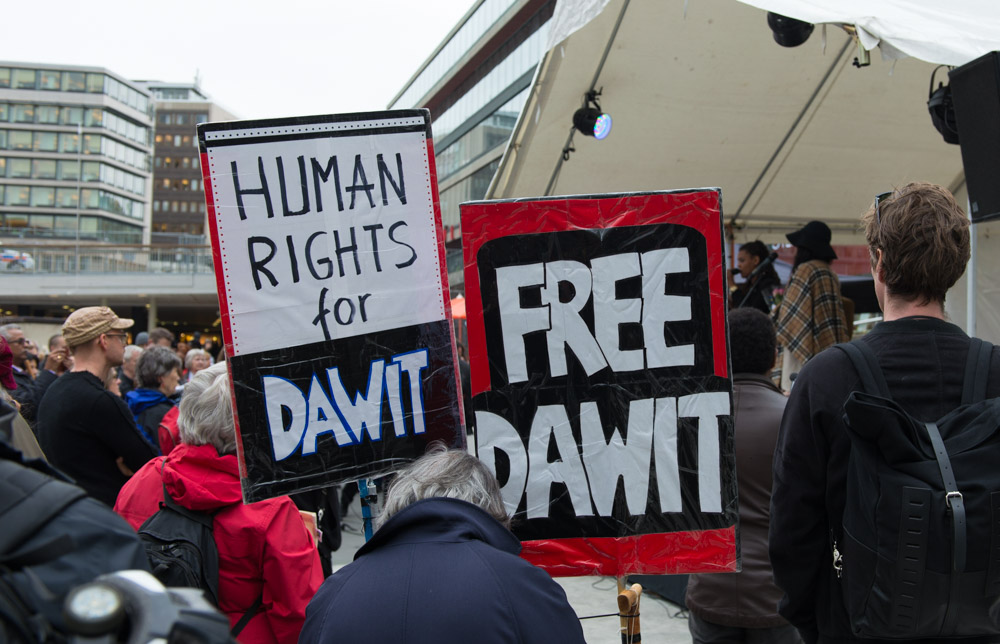
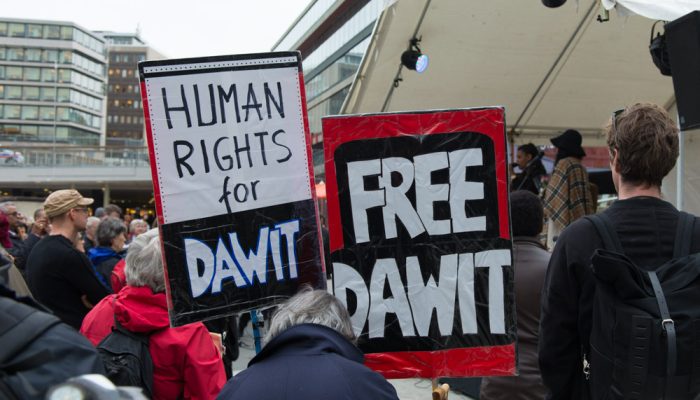
Placards at a June 2015 rally in Stockholm marking 5,000 days of Dawit Isaak’s detention. Photo: Frankie Fouganthin/Wikimedia Commons, CC BY-SA 4.0.
The European Parliament on Thursday demanded that Eritrea immediately and unconditionally release Dawit Isaak, a Swedish-Eritrean journalist held without charge or trial since September 2001.
Lawmakers adopted the resolution by 529 votes to 2, with 25 abstentions, the Parliament said. It calls his 25 years in detention arbitrary and expresses “grave concern for his life and safety.”
Until he is freed, the resolution asks Eritrea’s authorities for credible proof that he is alive, and for information on where he is held and on his health.
It also asks that his family, lawyers, Swedish consular officials and independent doctors be allowed to see him at once. It calls for an independent investigation into allegations of torture, and for those responsible to be held to account.
The resolution also urges the European Commission and the EU’s diplomatic service to make sure no EU funding “directly or indirectly benefits Eritrea’s state apparatus” until Dawit is released.
That condition also requires verifiable progress on the rule of law. The resolution asks EU governments to consider targeted sanctions against people responsible for serious human rights violations in Eritrea.
It calls on the EU’s foreign policy chief, Kaja Kallas, to step up diplomatic pressure together with Sweden and other EU states, BBC Tigrinya reported. The initiative was led by Evin Incir, a Swedish member of the Parliament.
In a statement carried by BBC Tigrinya, Incir said Dawit and his family had paid a very heavy price for free expression, and that the vote raised the pressure on Eritrea. She said the EU and Sweden must now take concrete steps to free him.
His daughter, Betlehem Isaak, was in the Parliament for the vote and welcomed it, the rights charity Human Rights Solidarity said. The Committee to Protect Journalists also welcomed the resolution.
Dawit fled to Sweden in 1987 and became a Swedish citizen in 1992, BBC Tigrinya reported. After Eritrea’s independence he went home, where he was a founder and editor of the newspaper Setit.
He was arrested at his home in September 2001. That month the government moved against senior officials and veteran fighters who had called for democratic reform and for the constitution to be put into force, a group known as the G-15.
Eritrea banned independent media that year, the resolution notes. State outlets have been the only domestic source of news since then, Borkena reported.
Dawit was released for a few days for medical treatment in November 2005 and then returned to prison. He has never been charged or brought before a court.
Other journalists from the closed newspapers were arrested with him. BBC Tigrinya named Fesshaye Yohannes (Joshua), Seyoum Tsehaye, Amanuel Asrat, Temesgen Gebreyesus, Mattewos Habteab, Medhanie Haile, Dawit Habtemichael, Said Abdelkader and Yusuf Mohamed Ali.
Like Dawit, they have been cut off from the world for a quarter of a century. Rights defenders and former prison guards have said the men were held at Eiraeiro, a prison in a remote desert area, BBC Tigrinya reported.
The Eritrean government has given no official information about whether they are alive or about their condition.
The African Commission on Human and Peoples’ Rights found the September 2001 arrests arbitrary and unlawful, the resolution notes. The UN Working Group on Arbitrary Detention reached the same finding about Dawit’s detention in 2023.
Sweden’s foreign minister sought his release during a visit to Eritrea in December 2025, according to the resolution. Sweden’s long policy of quiet diplomacy has drawn strong criticism from his family and press freedom groups because it has produced no result, BBC Tigrinya said.
Eritrea has repeatedly rejected calls from the EU, the UN and others to free Dawit and the other prisoners. It has called them interference in its sovereignty and said the case is a matter of national security, BBC Tigrinya reported.
Eritrea’s Information Ministry and the information minister, Yemane Gebremeskel, had not commented on the resolution on their X accounts by Saturday afternoon, East Africa time.
On the afternoon of the vote, Foreign Minister Osman Saleh briefed EU ambassadors based in Cairo on Eritrea’s dispute with Ethiopia, the Information Ministry said. Its account of the meeting did not mention Dawit.
Sources
- European Parliament, texts adopted, Nov. 26, 2026: resolution on Dawit Isaak (PDF)
- European Parliament press release, Nov. 26, 2026: Human rights violations in Eritrea, Georgia and Macao
- BBC Tigrinya, Nov. 27, 2026: European Parliament calls for journalist Dawit Isaak’s urgent release (Tigrinya)
- Committee to Protect Journalists (CPJ Africa) on X, Nov. 26, 2026
- Human Rights Solidarity on X, Nov. 26, 2026
- Borkena, Nov. 27, 2026: European Parliament demands torture probe in Eritrea
- Eritrea’s Ministry of Information on X, Nov. 27, 2026: Osman Saleh briefs EU ambassadors in Cairo (Tigrinya)
- Zegabi’s earlier reporting: 182417, 180881