
Fano Spokesman Says His Movement Would Answer Talks Led by International Bodies, Calling Abiy Ahmed’s Peace Appeal a Call to Surrender
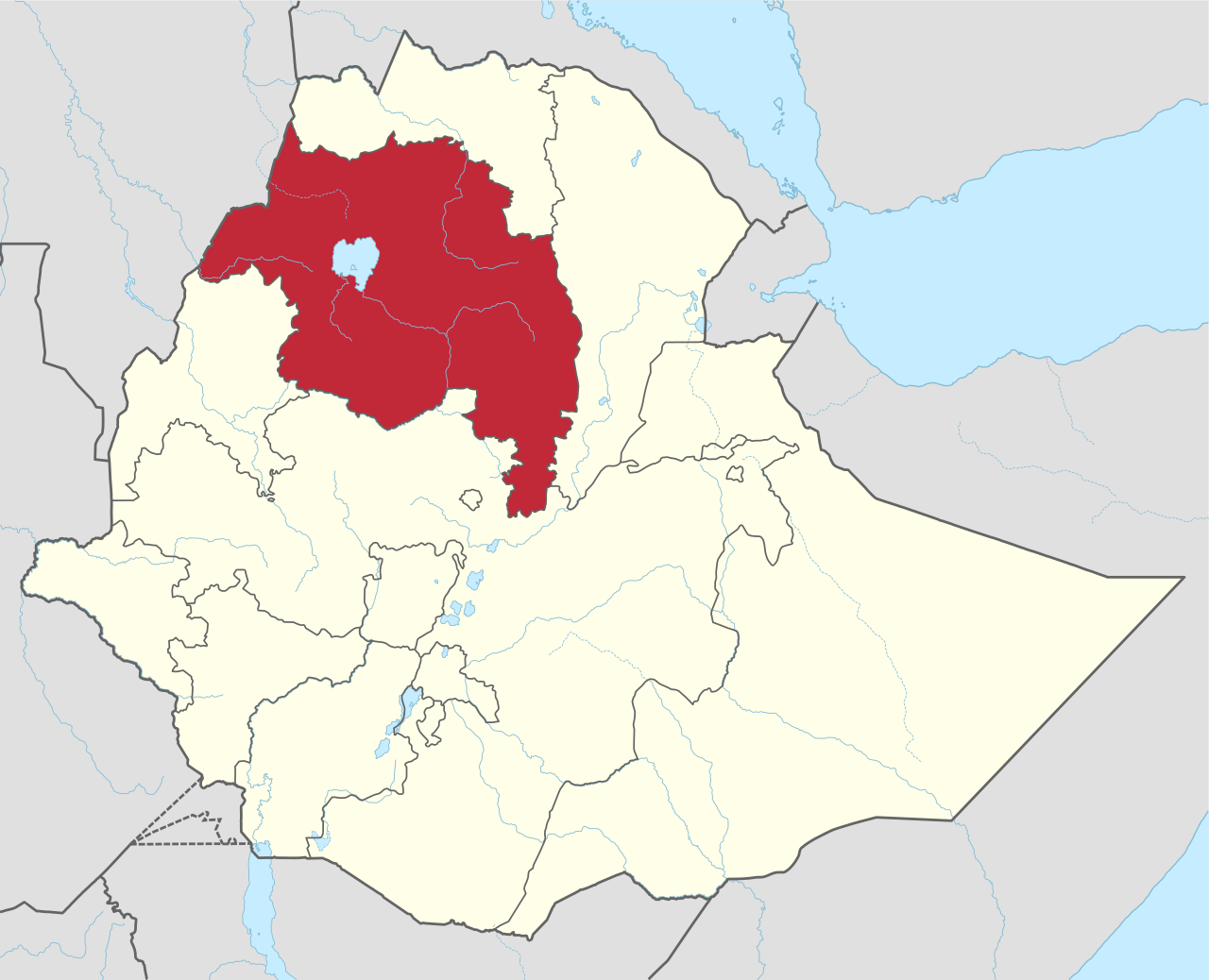
The Amhara region, where Fano forces have fought federal troops for more than three years. Map: TUBS / Wikimedia Commons, CC BY-SA 3.0.
Asres Mare Damtie, spokesman for the Amhara Fano National Movement (AFNM), says the movement is “ready to respond” to peace talks with the federal government if internationally accepted institutions lead and monitor them.
He told the radio program of BBC Amharic on Friday that the peace appeals from Prime Minister Abiy Ahmed and others were “calls to surrender, not calls to negotiate.”
Asres was answering the prime minister’s Thursday address to parliament. Speaking to armed groups, Abiy Ahmed said “you will never succeed” in bringing down his government, BBC Amharic reported.
“This government will last a very long time. It is better that you don’t trouble yourselves too much,” the prime minister said. He warned that his government thinks 20 times over for every step its opponents plan.
He urged the fighters to take the peaceful path, as he said “your brothers” from Oromia, Amhara and Tigray had done after coming in for talks. The same day, his office told armed groups on X that they were “better off returning to peace.”
In the same session, Abiy Ahmed said thousands of armed fighters were coming into the government’s fold across different regions, according to Addis Standard. The report gave no breakdown, and the figure could not be independently verified.
He also likened the armed groups in Oromia, Amhara and Tigray to an “autoimmune disease” that attacks its own community. He acknowledged that security forces alone could not keep people safe, the report said.
Asres rejected the prime minister’s account. “Especially with the Amhara force, nothing concrete has been done so far,” he told the BBC.
He said the authorities in Addis Ababa were instead trying to coax commanders and fighters in different areas into surrendering “through various tactics.” He said there had been no real effort to accept that the movement has a political question that can be settled through talks.
“If that willingness existed, to tell the truth, I believe Ethiopia’s peace could be restored to a great extent,” he said.
Asres said the movement has prepared its approach to talks in a written document. Talks must be led by “internationally accepted and experienced institutions,” he said, which should oversee them and follow how any deal is carried out.
“If a peace and negotiation request comes at that level, the Amhara Fano National Movement is ready to give an adequate response,” he said. “But most of what has been offered so far falls below that.”
Asres also described the talks between the movement’s chairman, Zemene Kassie, and Guang Cong, the UN Secretary-General’s special envoy for the Horn of Africa.
Addis Standard reported on Nov. 17 that the two men spoke by phone on Nov. 14, and that Asres also took part. Tigrai Media Corporation had first reported the talks, BBC Amharic noted.
Asres said Zemene spoke for both the AFNM and the Alliance for Survival. The coalition of seven armed groups includes the Tigray People’s Liberation Front (TPLF) and the Oromo Liberation Army (OLA), and Zemene leads it.
Peace talks were part of the discussion, Asres said. “We tried to propose that international institutions, including the UN, put appropriate diplomatic pressure” on Ethiopia, he said, so that its conflicts end through inclusive dialogue and a negotiated settlement.
He also spoke about Tigray, where federal forces took the region’s main towns within a short time after fighting resumed. Fighting is now taking place near the Eritrean border, residents told the BBC.
Asres said the federal push deep into Tigray had brought “unexpected military outcomes.” He said the alliance’s forces were working together to reverse them.
In Oromia, the regional government signed a peace deal in December 2024 with Sagni Nagasa, a former OLA commander. An OLA spokesman dismissed it as “fabricated drama” and said he had been expelled from the group months earlier, ACLED reported at the time.
Political violence in Amhara has risen since the alliance was formed in September. The conflict monitor ACLED recorded 130 events involving Fano forces in October, more than double September’s 51, with AFNM fighters involved in about 60% of them.
ACLED also said some Fano groups strongly oppose working with the TPLF. AFNM fighters clashed with one of them, the Fano Belay Zeleke Command, near Wegeda in South Gondar in late September, it said.
Lawmakers raised the cost of the fighting for civilians in Thursday’s session. Awoke Amzaye, an EZEMA member of parliament, said killings of civilians, looting, sieges and road closures had reached an “extremely alarming level,” DW Amharic reported.
The prime minister told parliament the security problems would be solved “step by step,” according to DW. Abraham Haimanot, president of the Ethiopian People’s Revolutionary Party, told the broadcaster he did not believe the reality had been properly described.
Sources
- BBC Amharic, Nov. 28, 2026: AFNM spokesman Asres Mare on talks (Amharic)
- Office of the Prime Minister on X, Nov. 26, 2026: message to armed groups
- Addis Standard, Nov. 26, 2026: Abiy Ahmed in parliament
- Addis Standard on X, Nov. 17, 2026: Zemene Kassie and Asres Mare’s call with Guang Cong
- DW Amharic, Nov. 27, 2026: security and human rights in Thursday’s parliament session (Amharic)
- ACLED, Nov. 11, 2026: Political violence in Amhara escalates following the formation of the Alliance for Survival
- ACLED, Ethiopia Weekly Update (10 December 2024)
- Mereja TV on X, Nov. 16, 2026: Zemene Kassie and the UN envoy
- Zegabi’s earlier reporting: 181343, 181332, 182300