Analysts Warn of a Proxy War Between Ethiopia and Sudan as Each Accuses the Other of Arming Its Enemies
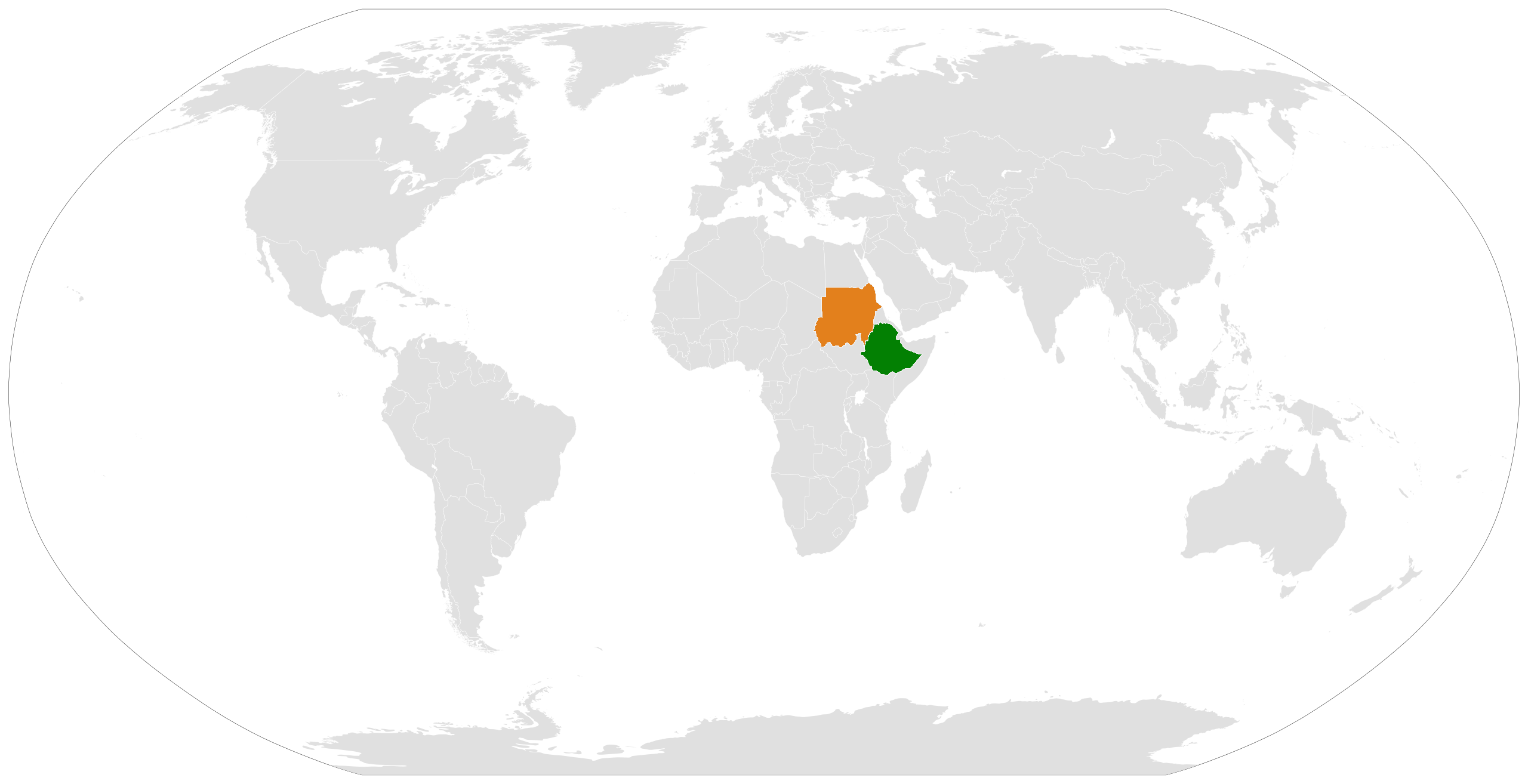
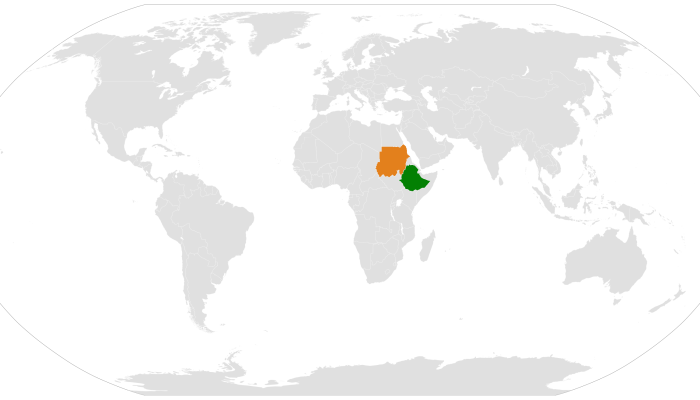
Ethiopia, in green, and Sudan, in orange, share a border of roughly 750 kilometers that has never been fully marked on the ground. Map: PlanespotterA320/Wikimedia Commons, CC0
Analysts are warning that Ethiopia and Sudan could slide into a proxy war, as each government accuses the other of arming the rebels it is fighting and both deny the charges.
“All the ingredients are present for an intensifying proxy war between Ethiopia and Sudan that further destabilizes both countries,” Alan Boswell, Horn of Africa project director at the International Crisis Group, told The Associated Press in a report published on Sunday. Sudan’s army says Ethiopia lets the paramilitary Rapid Support Forces (RSF) set up camps, launch drones and stage attacks from its soil. The Ethiopian federal government says Sudan’s army backs the Tigrayan forces fighting federal troops. The AP said it could not independently verify either side’s claims.
Sudan has put its case on paper. It lodged complaints against Ethiopia with the UN Security Council and the African Union’s Peace and Security Council at the start of November, Reuters reported. A report by Sudan’s Foreign Ministry and military intelligence claimed that 70 attacks using 187 one-way drones were launched from Ethiopian territory between February and October. That included 28 attacks with 97 drones in October, Al Jazeera reported. Al Jazeera, citing a report by Sudan’s Transitional Sovereignty Council, said those attacks killed 484 civilians and 176 soldiers between Feb. 15 and Oct. 27. BBC Tigrinya reported the figure of 484 civilians and said it could not verify it independently.
Some outside researchers have found evidence that points the same way, though none has tied it to orders from the Ethiopian Government. Yale University’s Humanitarian Research Lab, which studies satellite images, found a buildup of military vehicles and equipment at an Ethiopian army base in Asosa in late August and linked the buildup to the RSF, the AP reported. The same laboratory had already reported in April, with high confidence, activity consistent with military assistance to the RSF at that base. “The RSF is engaged out of Ethiopia … to try to open a second front,” the lab’s head, Nathaniel Raymond, told the agency. Addis Standard reported that a UN fact-finding mission said in September it had found Ethiopian nationals among the RSF’s foreign fighters. The mission found no evidence that Ethiopia’s government had sent them or given them weapons or money, the paper said.
Ladd Serwat, a senior Africa analyst at the conflict monitor ACLED, told the AP that relations soured late last year, when the RSF set up camps on Ethiopian territory. He said Ethiopia’s help to the RSF was mainly logistical and that the United Arab Emirates, Ethiopia’s ally, was the RSF’s main backer. The UAE has repeatedly denied any role in Sudan’s war. Ethiopia and the UAE also denied a Reuters investigation in February that said Ethiopia was hosting an Emirati-funded camp in Benishangul-Gumuz to train RSF fighters, BBC Tigrinya noted.
The authorities in Addis Ababa have called Sudan’s accusations baseless and have pointed the finger back at Khartoum. In September the army chief, Field Marshal Birhanu Jula, suggested that Sudan, Eritrea and Egypt were backing the rebels, and all three denied it, the AP said. Earlier this month the Ethiopian government showed diplomats weapons it said had been captured from the TPLF and claimed that the three countries had supplied them. On Nov. 3 it ordered six staff at Sudan’s consulate in Asosa to leave within 48 hours, and Sudan answered by expelling Ethiopian diplomats from Gedaref, Reuters and BBC Tigrinya reported. The prime minister’s office did not respond to Reuters when it asked about Sudan’s complaints.
Khartoum says it wants to avoid a fight. “The Sudanese government remains committed to its right to defend its territory. Nevertheless, it is making every possible effort to avoid an open war with Ethiopia,” Amjad Farid, an adviser to Sudan’s Transitional Sovereignty Council, told Reuters. Abdi Kayd Buraal, an Ethiopian analyst of the Horn of Africa, told BBC Tigrinya that a direct war between the two countries was unlikely. Abdi said the rivalry was more likely to play out through proxies and political pressure, as it long has.
Others are less sure. Abdurahman Sayed Abuhashim, a Middle East and Horn of Africa analyst, told BBC Tigrinya that the war with the TPLF or with Eritrea could widen. In that case, he said, Addis Ababa might try to secure Gedaref and Kassala, directly or through the RSF, to block threats coming through Sudan. He also pointed to Al-Fashaga, a fertile farming strip near Ethiopia’s Amhara and Tigray regions that Sudan holds and Ethiopia claims. Ethiopian farmers worked that land for years before Sudanese troops moved in during late 2020, according to the AP, citing the International Crisis Group.
The fighting has already reached civilians near the frontier. In October a drone strike blamed on the RSF hit a gathering of displaced people on Sudan’s border with Ethiopia and killed 41, the Sudanese rights group Emergency Lawyers told the AP. Sudan’s war has killed at least 59,000 people by ACLED’s count and displaced about 13 million, and the Yale lab warned that the border tension, if ignored, could lead to mass displacement.
Sources
- The Associated Press, Nov. 15, 2026: Ethiopia and Sudan accuse each other of backing armed fighters as fears of a wider conflict grow
- Reuters, Nov. 4, 2026: Ethiopia and Sudan close each other’s consulates after allegations of meddling in civil war
- Al Jazeera, Nov. 3, 2026: Deadly RSF drone attacks reveal deep divisions between Sudan and Ethiopia
- BBC Tigrinya, Nov. 12, 2026: Where could the Sudan–Ethiopia tension lead, and who is on the border? (Tigrinya); same report in BBC Afaan Oromoo
- Addis Standard, Oct. 14, 2026: Sudan says dialogue with Ethiopia possible if it stops supporting RSF
- Zegabi, Nov. 9, 2026 (180861) and Zegabi, Nov. 5, 2026 (180419)