Kenyan Official Says About 35,000 Ethiopians Have Fled Moyale Fighting Into Kenya
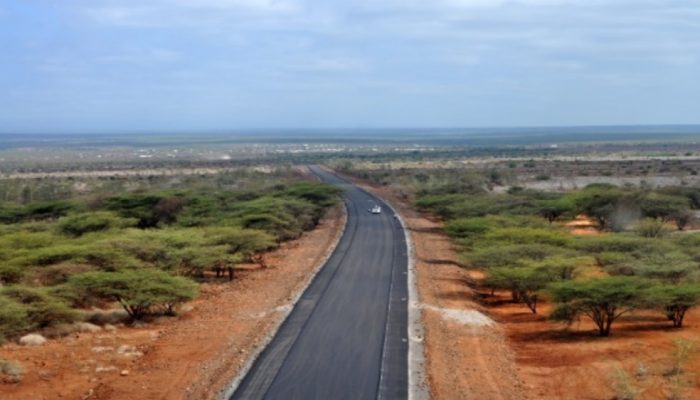
A road leading to Moyale, the town divided by the border between Ethiopia and Kenya, in 2015. [file photo] [Wikimedia Commons, George Kaguangi, CC BY-SA 2.0]
About 35,000 Ethiopians have crossed into Kenya to escape the fighting between Oromia and Somali regional forces in the border town of Moyale, the county commissioner of Kenya’s Marsabit County said, according to the Kenya News Agency.
Stanley Kamande, the Marsabit county commissioner, gave the figure during a visit to Moyale on Saturday to look at security on the border and at conditions for the families who have fled, the Kenya News Agency reported on Sunday. He said about 15,000 people were living in camps and about 20,000 more had been taken in by local families, and that they badly needed blankets, tents, mosquito nets and toilets because the nights were cold and the sanitation was not enough. On Friday, Kamande told Reuters that at least 2,500 displaced Ethiopians were staying in Kenya’s Moyale town. His new total counts the 20,000 he said were living with local families, and neither he nor the agency explained how the figure had grown so quickly. The Kenya Red Cross count of more than 14,000 includes about 4,000 people staying with relatives and friends.
Malik Adan, who heads the Kenya Red Cross in the Upper Eastern region, told reporters on Saturday that more than 10,900 people were staying in six temporary camps in Kenya’s Moyale and more than 4,000 others were living with relatives and friends. “We urgently need more well-wishers to support us with food and water. There is also a need for sanitary supplies and more toilets to avert diarrheal diseases,” he said, according to Anadolu Agency and the Daily Nation. The Red Cross is handing out shelter kits meant for 1,000 households, along with blankets, sleeping mats, jerrycans and fortified cereal for young children and mothers, and the Marsabit county government has given rice and beans, which Adan said would not last long. Abdi Suku, the health officer for Moyale sub-county, told the Kenya News Agency that the camps were overcrowded and that three suspected measles cases had been isolated while samples went to the Kenya Medical Research Institute for testing. Two women have given birth in the camps, he said.
Trade through one of the busiest crossings between the two countries has stopped. Trucks cannot carry goods across the border in either direction, and several shops near the One-Stop Border Post on the Kenyan side have shut because of stray bullets, the agency said. A Kenyan police report seen by Reuters said a stray bullet had lodged in the neck of a woman in Kenya’s Moyale, and that she was in stable condition after it was removed.
Nobody has published a confirmed death toll. An official at the hospital on the Ethiopian side of Moyale told Reuters that about 30 wounded people had been brought in over several days, most of them hurt by “heavy weapons,” and that four of them died on Thursday and five on Friday. A resident told BBC Amharic that nine people, fighters and civilians among them, were killed on Friday alone, a number the BBC said it could not confirm from other sources. The conflict monitor ACLED told AFP that the confrontation over the flag killed a 13-year-old girl and that at least five other people had died, and AFP said it could not verify the toll. “Somali fighters are firing heavy weapons from large buildings in the town while Oromia forces are fighting back,” a resident, Wako Ganale, told AFP by phone on Saturday. Another resident, Hussein Halkeno, said “several civilians had been killed and wounded.” AFP said gunfire could be heard during both calls.
The fighting grew out of a dispute over the raising of the Somali regional flag in Moyale, a town the two regions share, which BBC Amharic said began on Sunday, Oct. 18, and turned deadly when the girl was killed. By Sunday, the BBC said, there had still been no comment from officials of the Oromia or Somali regional governments or from the federal government in Addis Ababa. AFP said Abiy Ahmed’s regime had yet to respond when it filed on Saturday.
The opposition Oromo Federalist Congress (OFC) criticized that silence in a statement on Saturday. It blamed armed groups it said had come “from the Somali region” for a rise in border violations around Moyale and the Borana zone, and accused them of trying to seize land, push out Borana Oromo herders and redraw administrative lines on their own. “The federal government can no longer choose silence or use historical complexity as an excuse for not acting,” the party said, in BBC Amharic’s report of the statement, translated by Zegabi. It also blamed the Oromia regional government for failing to protect residents, and called for a “transparent, independent and speedy investigation” into the girl’s death and the attacks on other civilians, with everyone responsible “at every level, including those who gave the orders,” brought to court, according to the BBC and the OFC statement as published by Ethio Affairs.
Some of the people now in Kenya told the Kenya News Agency they simply want the fighting to end. Bashir Ali, who fled the Ethiopian side, asked the Kenyan and Ethiopian governments to protect civilians and help stop the violence, saying many families left without their belongings. Kulong Duoth, a trader from Ethiopia’s Gambella region who had gone to Kenya to buy goods, said he was stuck and could not get home. Kenyan authorities have sent more security personnel to the border.
On X, Rapani M.ali (@McRapani) posted two photos on Sunday and wrote in Somali, “It is the Ethiopian military, and now it is firing on the people of Moyale.” No outlet has reported federal troops joining the fighting, and eyewitnesses told Addis Standard last week that neither the army nor the federal police had stepped in. Obsinaan Adabaa Alakuu (@ObsinaanAdaba) wrote in Amharic that “everyone who stirs up conflict inside Oromia should face legal action,” adding, “Moyale needs peace, justice and living together.” Mahmoud Ismail (@Mahmoud87980493) wrote in Arabic that about 10,000 people had fled to Marsabit while “Ethiopia’s elite talks only about Egypt and leaves the massacres and the civil war in the regions.”
Sources
- Kenya News Agency, “Some 35,000 Ethiopians seek refuge in Moyale-Kenya as conflict escalates,” Oct. 25, 2026
- Anadolu Agency, “Over 14,000 flee Ethiopia clashes into Kenya as death toll feared to rise,” Oct. 24, 2026
- Daily Nation, “Ethiopia crisis: Red Cross says 14,000 refugees who fled to Kenya face food, water shortages,” Oct. 24, 2026
- Reuters via Arab News, “Fighting in Ethiopia border town kills nine, thousands flee to Kenya,” Oct. 23, 2026
- AFP via Arab News, “Several dead in clashes between rival Ethiopia regional armies,” Oct. 24, 2026
- BBC Amharic, “ኦፌኮ የሞያሌ ከተማ ግጭትን በተመለከተ የፌደራል መንግሥት ‘ዝምታ መምረጡን’ ተቸ,” Oct. 25, 2026
- Ethio Affairs, “OFC Condemns Violence in Moyale, Calls for Investigation into Death of 13-Year-Old Girl,” Oct. 24, 2026
- DW Amharic on Telegram, AFP report on Moyale, Oct. 24, 2026
- Addis Standard via allAfrica, “Ethiopia: Fighting in Border Town Moyale Spreads to Three More Districts, Exchange of Heavy Gunfire,” Oct. 23, 2026
- Zegabi, “Ethiopians Flee Into Kenya as Fighting Between Oromia and Somali Regional Forces Spreads Beyond Moyale and Kenya Sends Troops to the Border, Reports Say,” Oct. 23, 2026
- Rapani M.ali (@McRapani) on X, Oct. 25, 2026
- Obsinaan Adabaa Alakuu (@ObsinaanAdaba) on X, Oct. 25, 2026
- Mahmoud Ismail (@Mahmoud87980493) on X, Oct. 24, 2026