Alliance for Survival Rejects Rubio’s “Separatist” and “Terrorism” Descriptions, Urges Washington to Take a “Balanced” Stance on Ethiopia’s War
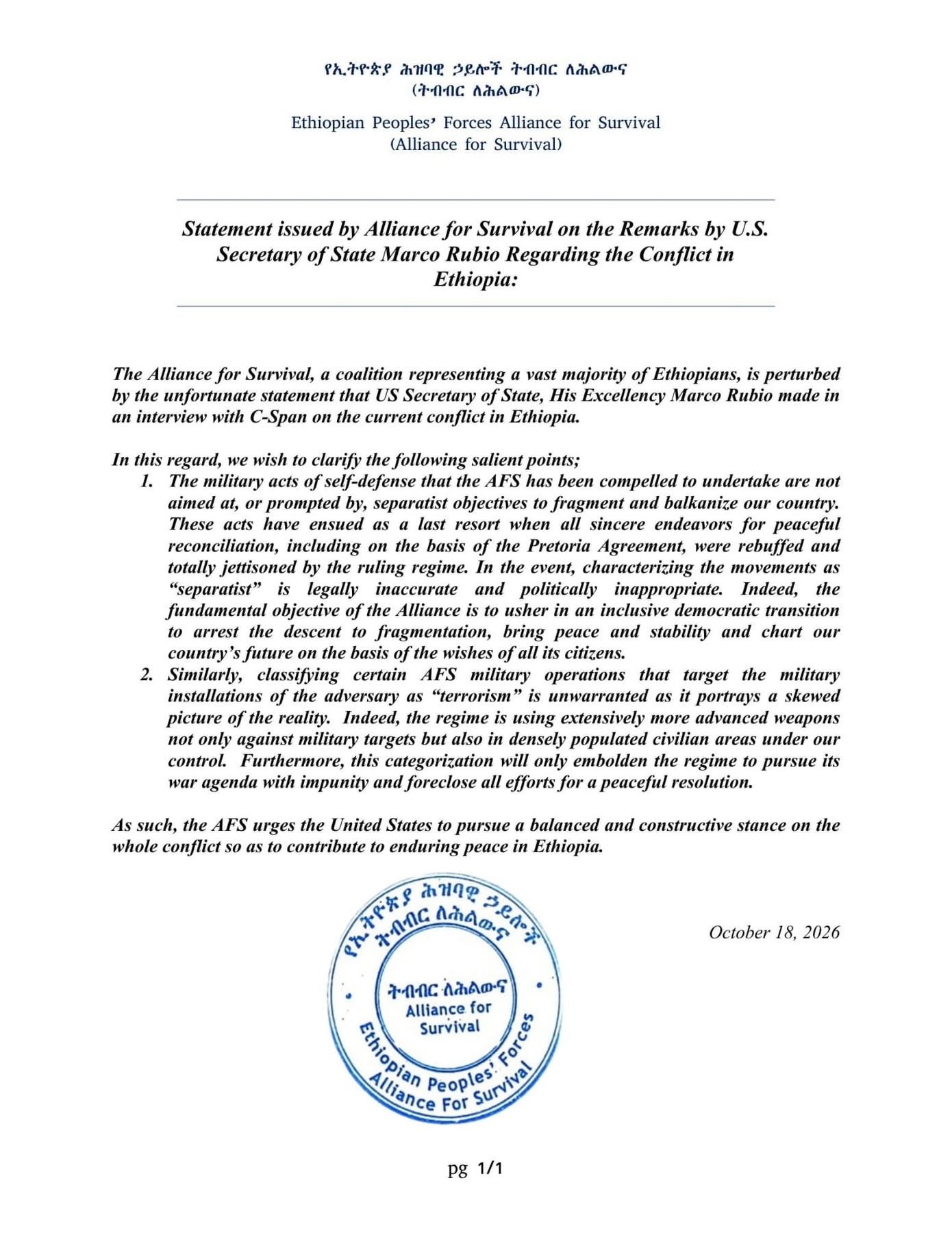
The Alliance for Survival’s statement on Marco Rubio’s remarks, dated Oct. 18, 2026, as posted on X by the Amhara Fano National Movement’s foreign affairs office. [Alliance for Survival statement via @AFNM_FA on X]
The Ethiopian Peoples’ Forces Alliance for Survival, the coalition of armed and political groups fighting the federal government, has rejected U.S. Secretary of State Marco Rubio’s description of the forces attacking inside Ethiopia as “separatists” and of strikes on government military sites as terrorism, and has asked Washington to take what it called a balanced position on the war.
The one-page statement, dated Oct. 18 and bearing the alliance’s seal, was posted on X at 7:07 p.m. ET on Sunday by the foreign affairs office of the Amhara Fano National Movement (AFNM), one of the coalition’s members. It said the alliance was “perturbed by the unfortunate statement” Rubio made “in an interview with C-Span” on the conflict. The remarks it was answering were given to reporters at Joint Base Andrews in Maryland on Saturday night, according to the State Department transcript, before Rubio left for Uzbekistan and India.
Asked how high the risk of war between Ethiopia and Eritrea was, Rubio had said, “You have these separatists that were attacking inside of Ethiopia. You had an Ethiopian response to it. You see troops surging on both sides of the border as a result of that.” Addressing the Ethiopian side, he added that “we understand the challenge you’re facing from these separatists, and obviously no one is supportive of terrorism and the terrorist attacks that came against them, drone attacks against their own capital,” while urging the authorities in Addis Ababa to be “wise and measured” so the crisis does not become a broader war. Rubio did not name any group.
The alliance answered in two points. On the first, it said “the military acts of self-defense that the AFS has been compelled to undertake are not aimed at, or prompted by, separatist objectives to fragment and balkanize our country,” and that they came “as a last resort when all sincere endeavors for peaceful reconciliation, including on the basis of the Pretoria Agreement, were rebuffed and totally jettisoned by the ruling regime.” Calling the movements separatist, it said, “is legally inaccurate and politically inappropriate.” The coalition said its aim is “to usher in an inclusive democratic transition to arrest the descent to fragmentation, bring peace and stability and chart our country’s future on the basis of the wishes of all its citizens.”
On the second point, the statement said that “classifying certain AFS military operations that target the military installations of the adversary as ‘terrorism’ is unwarranted as it portrays a skewed picture of the reality.” It accused the regime in Ethiopia of using “extensively more advanced weapons not only against military targets but also in densely populated civilian areas under our control,” and warned that the label “will only embolden the regime to pursue its war agenda with impunity and foreclose all efforts for a peaceful resolution.” It closed by urging the United States “to pursue a balanced and constructive stance on the whole conflict so as to contribute to enduring peace in Ethiopia.” Addis Standard, which reported the statement on Monday, said it could not independently verify the alliance’s allegations about the use of weapons in civilian areas.
The statement did not address the drone attacks on Addis Ababa that Rubio mentioned, and it did not say which member groups had approved it. The alliance’s formation was announced on Sept. 20 in a statement read on Tigrai TV by Zemene Kassie, chairman of the AFNM, and Addis Standard lists its members as including the Tigray People’s Liberation Front (TPLF), the Oromo Liberation Army (OLA) and the AFNM, among other groups. The Ethiopian federal government had not responded publicly to the statement by Monday afternoon. A State Department spokesman, responding to questions from Mereja, said the United States reiterates its call for Ethiopia and Eritrea to respect the sovereignty and territorial integrity of their neighbors, and that the message has been delivered privately and publicly to both sides over the last six months. The spokesman said Rubio spoke with Prime Minister Abiy Ahmed on Oct. 14 to stress those messages, Mereja reported.
The exchange came as Independent Arabia asked in a Monday headline whether Rubio’s remarks were “paving the way” for the opposition to be designated as “terrorist.” Nothing in the State Department transcript points to a designation, and the department has announced none.
On X, the statement and Rubio’s words drew sharp and divided responses in several languages. Sherin Helal (@sherinhelal555), whose bio describes her as an Egyptian writer and researcher, wrote in Arabic that “التحالف الإثيوبي من أجل البقاء يلقن وزير الخارجية الأمريكي درسا” (“the Ethiopian Alliance for Survival teaches the U.S. secretary of state a lesson”), arguing that Rubio had failed to distinguish between “الانفصاليين” (“separatists”) and liberation fronts. An Amharic-language account, @7AntRise, took the opposite view in a long post, writing that Rubio’s “ገንጣይ” (“separatist”) label “በእውነት ላይ የተመሠረተ እንጂ የተሳሳተ ፍረጃ አይደለም” (“is based on fact, not a wrong label”), and pointing to the alliance’s own language about deciding the country’s future through popular and constitutional dialogue. Thomas C. Mountain (@thomascmountain), whose bio says he lived and reported from Eritrea from 2006 to 2021, wrote that Rubio “shot US in the foot by condemning Ethio Alliance for Survival as separatist and terrorists.” Maebel Kiflay (@kiflaymaebel1) posted a Tigrigna rendering of Rubio’s remarks with a video clip, opening with the line that Rubio had called the forces attacking in Ethiopia “ተገንጸልቲ” (“separatists”). Replying to the AFNM foreign affairs post, an account posting as @Abethegreat28 asked in Amharic whether Ethiopians in North America would quickly put a clear position to Rubio “or waste time on analysis.” Translations from Arabic, Amharic and Tigrigna are Zegabi’s. Zegabi has not verified the claims made in these posts.
Sources
- Alliance for Survival statement, posted by Amhara Fano National Movement Foreign Affairs (@AFNM_FA) on X, Oct. 18, 2026
- U.S. Department of State, “Secretary of State Marco Rubio Remarks to the Press,” Joint Base Andrews, Oct. 17, 2026
- Addis Standard via allAfrica, “Alliance for Survival Rejects Rubio’s Characterization of Ethiopia’s Conflict As Separatist, Terrorist,” Oct. 19, 2026
- Mereja, “Alliance for Survival rejects Rubio’s “separatist” and “terrorist” labels, asks Washington for a balanced stance,” Oct. 19, 2026
- Independent Arabia (@IndyArabia) on X, Oct. 19, 2026
- Sherin Helal (@sherinhelal555) on X, Oct. 19, 2026
- @7AntRise on X, Oct. 19, 2026
- Thomas C. Mountain (@thomascmountain) on X, Oct. 19, 2026
- Maebel Kiflay (@kiflaymaebel1) on X, Oct. 18, 2026
- @Abethegreat28 on X, Oct. 19, 2026