
Parents at North Wollo’s Jara Camp Tell DW Their Children Are Out of School After Teachers Were Moved, as a Zone Official Says Classes Continue
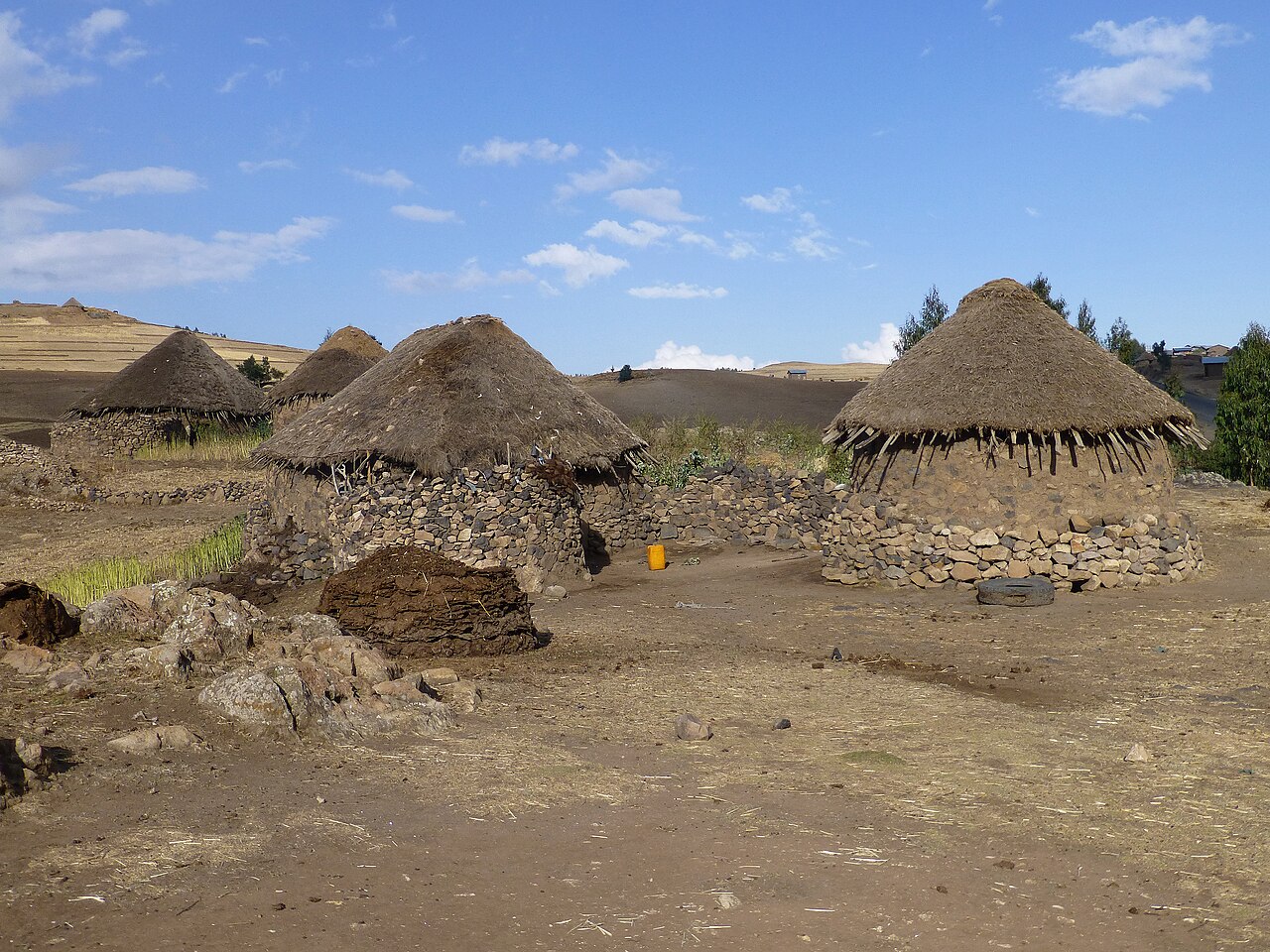
File photo of rural homesteads between Weldiya and Lalibela in North Wollo, 2014. The picture does not show the Jara camp. Photo: Ji-Elle/Wikimedia Commons, CC BY-SA 3.0
Families living at the Jara camp for displaced people in North Wollo say their children have been shut out of school this year because the camp has lost its teachers, DW Amharic reported on Friday.
The camp sits in Habru district of the Amhara region and shelters people who fled fighting in the Oromia and Benishangul-Gumuz regions at different times. Of more than 2,800 students at the camp, from pre-primary to grade 12, more than 1,500 have not gone to school this year, DW Amharic said in its report. The quotations here are Zegabi’s translation from the Amharic.
Aliyu Ahmed, who lives at the camp, told DW that in past years the children studied in a school built of canvas inside the camp. Last year classes ran up to grade six with teachers hired by the government, he said. About 10 teachers had been assigned there, but they were moved back to a place called Ajo Meda, seven kilometers away, and classes in the camp stopped.
Aliyu said the school had been a comfort to families who had lost their homes. “After we came here, after we entered the Amhara region, we thought our children would at least make up for that injustice,” he said. “We thought our children would get enough education. That was one of the things that comforted us.”
Ahmed Ali, who coordinates the camp committee, said children in grades one, five and six have not gone to school at all this year. Some walk to Ajo Meda and back every day because they would rather do that than sit at home, he said. He said the walk exposes them to traffic accidents, human traffickers and sexual violence, and that someone had died, though he gave no details. Zegabi could not independently verify his account.
Lubaba Getnet, who also lives at the camp, said parents had hoped their children’s schooling would make up for their own. “Even if we go without, go hungry and go thirsty, it does not matter, as long as our children get an education,” she told DW. “What makes us lose hope now is that our children’s schooling has stopped.”
The two officials who spoke to DW described the problem differently. Mengesha Dereje, who heads the Habru district education office, said the district has no budget set aside for the camp and that keeping classes going without help from aid groups is hard. The district had hired about 16 teachers for the camp, he said, but the need is large and “it is not something the district budget can cover.”
Mengesha said his office was now talking with the Amhara Development Association, known as ALMA, in the hope that it could supply teachers for the youngest children. Setegn Tadesse, who heads the North Wollo zone education department, told DW that schooling “has not stopped.” He said pupils in grades five to eight now study at Ajo Meda, while grades one to four and an accelerated learning program stay at the camp.
Setegn said the change was meant to sort out a mix-up between programs. He said there were 11 teachers at the camp and that any missing teachers would be replaced. DW reported that there are more than 30,000 displaced people in North Wollo zone, who came from different parts of Ethiopia over the past six years.
Jara has a long record of shortages. In February 2024, Addis Standard reported that thousands at the camp had held a peaceful protest after going more than two months without food rations. The outlet said then that more than 10,000 people had sought refuge at Jara since 2018, most of them fleeing conflict in Oromia, and that local officials had ordered the displaced people to leave.
In June 2025, a man at the camp who had fled Kiremu district in East Wollega spoke to Addis Standard. He said he received 15 kilograms of maize, 1.5 kilograms of peas and 0.45 liters of oil a month. “The shelter was built in 2022 for six months. Now, it’s been three years,” he said. A report that year by the Ethiopia Emergency Shelter and NFI Cluster, which coordinates shelter aid, described “severely deteriorating” conditions at Jara and four other camps in North and South Wollo.
Other families from Wollega have come under attack in their camp. On Oct. 29 a drone strike hit the Jari 2 camp near Hayk in South Wollo, which shelters Amhara families driven out of Wollega. Residents and a hospital source told the BBC that 18 people were killed, Zegabi reported. A woman at that camp told Addis Standard that people from Kellem Wollega and Kiremu had been told since 2024 to go home, but many came back after being stopped from reaching their villages.
The gap at Jara is part of a wider one across the Amhara region, where three years of fighting between federal troops and Fano forces have closed schools. As of Sept. 10, 2026, more than 4.7 million students, or 62 percent of the 7.6 million targeted for this school year, had registered, The Reporter reported.
In October 2025, regional communication officials said 2,445 of the region’s 11,069 schools were still closed and more than 1,000 were being used for other purposes, the paper said. The Amhara Regional Civil Society Organisations Council said in September that about 3.1 million children were out of school or unregistered in the 2025/26 school year, FSX Business reported.
Aid money for the displaced has been shrinking at the same time. In October, people in other Amhara camps told Addis Standard that aid groups were scaling back or leaving because of funding cuts. One registered resident said food came only once every four months.
Sources
- DW Amharic, Nov. 20, 2026: displaced people at North Wollo’s Jara camp say their children have been kept out of school (Amharic)
- Addis Standard, Feb. 12, 2024: thousands at Jara IDP center without food aid for over two months
- Addis Standard, June 13, 2025: IDPs at Bakelo and Jara camps report prolonged aid delays
- Addis Standard, Oct. 6, 2026: critical humanitarian shortages threaten Amhara IDPs amid NGO withdrawals
- Addis Standard, April 9, 2025: dire shelter crisis grips IDPs in North and South Wollo
- Addis Standard, Nov. 2, 2026: survivors flee Hayiq Jari IDP camp after deadly drone strike
- The Reporter, Oct. 3, 2026: regional directive to establish an Amhara education fund
- FSX Business, Sept. 16, 2026: Amhara conflict leaves 3.1 million children out of school
- Zegabi’s earlier reporting: 179864, 179633