Eritrea’s Information Ministry Says Asmara Will Not Negotiate Its Sovereignty ‘Under Any Circumstances,’ Days After Ethiopia’s Navy Chief Spoke of ‘Other Alternatives’ for Sea Access
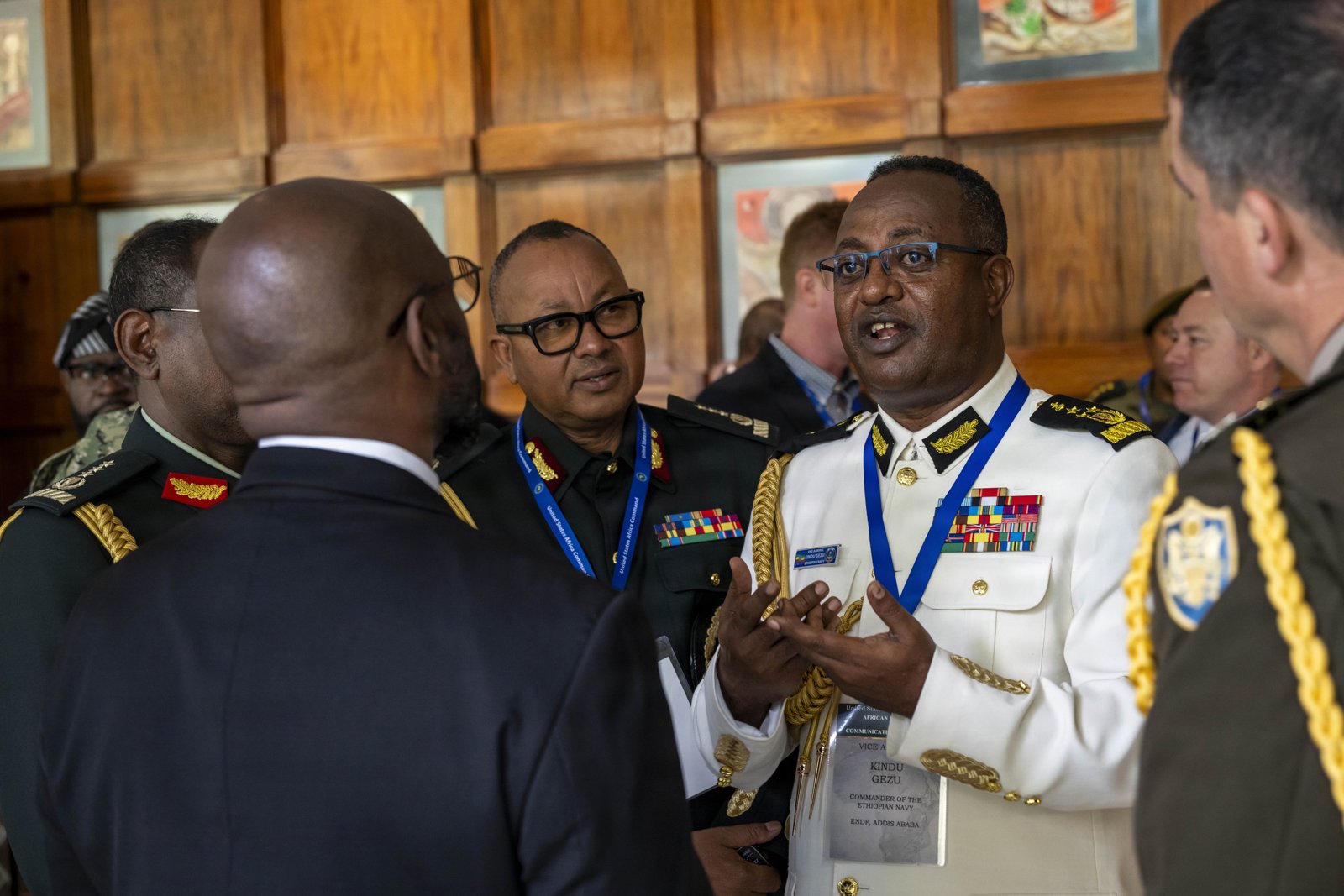
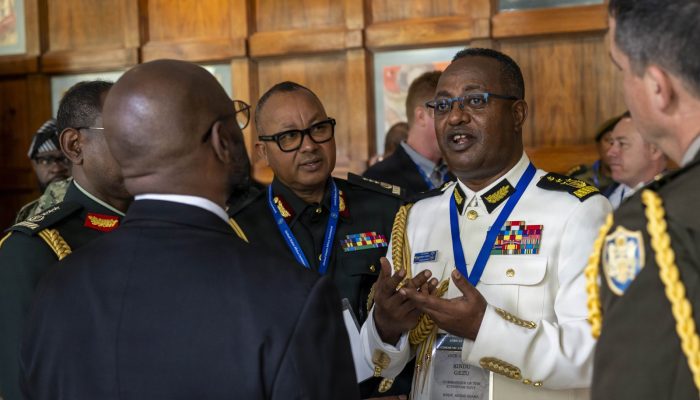
Vice Admiral Kindu Gezu, commander of the Ethiopian Navy, at the Africa Logistics and Communications Symposium in Addis Ababa on July 27, 2026. File photo. Photo: U.S. Navy photo by Mass Communication Specialist 2nd Class Samuel Wagner (public domain), via Wikimedia Commons
Eritrea’s Ministry of Information said in a Tigrigna commentary on Monday that the country’s sovereignty, independence and territorial integrity are not open to bargaining and that Eritrea will not make concessions or hold talks on them “under any circumstances,” two days after Ethiopia’s navy commander was reported as saying that Ethiopia would win back sea access “through diplomacy, law, or other alternative.”
The commentary, which takes its title from the Tigrigna proverb “He who seeks what is not his wears out like a shoe,” was posted by the ministry on its X account (@shabait) and on its website, Shabait, and Information Minister Yemane Gebremeskel shared parts of it on his own account. The ministry said in a reply on X that the piece was a commentary being broadcast to Eritreans on radio and television and in newspapers, and Shabait files it under Editorial. “The sovereignty, independence and territorial integrity of the State of Eritrea are non-negotiable, inviolable and absolute,” it said, adding that the government had followed “a strategy of great patience and restraint” in the face of what it called continuing provocation and a planned campaign against the country (our translation from Tigrigna).
The commentary accused Ethiopia’s ruling Prosperity Party of openly breaking international agreements and law in an intense drive to take control of Eritrea’s sovereign waters “willingly or by force,” on grounds the party describes as “strategic importance” or “economic interest,” and said this put international law, the UN Charter, African Union decisions and Africa’s borders at risk. It said Eritrea, while ready for peace, would not make concessions or negotiate on its sovereignty “under any circumstances, whether through preconditions or threats of violence,” and that it had an inalienable right under international law to defend itself against a government it accused of trying to invade what is not its own and push the region into deeper crisis. It repeated a line President Isaias Afwerki used in May 1998: “We will not give what is ours, and we do not want what is not ours.” The commentary offered no evidence for its accusations and did not name any Ethiopian official.
Kindu Gezu’s remarks were reported on Saturday by Sputnik Africa, whose correspondent attended a symposium for former military and police personnel in Addis Ababa. Kindu called the loss of sea access one of the tragedies of Ethiopia’s history and said the country’s link to the Red Sea “has existed for thousands of years,” and he said that “through diplomacy, law, or other alternative” the Ethiopian people and government would regain the port and sea access lost “through illegal means,” according to Sputnik. He did not say what the other alternative would be or name any country. HahuPrime, citing Somali Report, said he also stressed that Ethiopia’s demand was not driven by territorial expansion or plans for military aggression and that dialogue under international law remained the preferred route.
BBC Tigrinya, in its report on the Eritrean commentary, said Kindu had described the way Eritrea won its independence from Ethiopia as unjust and illegal and had spoken of force as a last option “to return Assab to its motherland” if diplomacy fails (our translation from Tigrigna). DefenceMENA said it could not find a transcript or report of the speech from the Ethiopian News Agency or the army, and that the word “unjust,” which appeared in an Arabic post about the speech on X, was not in the reports it reviewed. Zegabi has not seen a full recording or transcript of the speech. On Oct. 30, after a regional maritime forum in Addis Ababa, Kindu had said that Ethiopia’s return to a seaport was inevitable and needed dialogue with neighboring states, The Abay Times reported.
On X, Freweini Ghebresadick (@Freweini_Ghebre), who says in her bio that she is American by nationality and Eritrean by birth, wrote on Monday that “Maj. Gen. Kindu Gezu Tegegn has again spoken about invading Eritrea,” adding: “Nothing in this speech concerns commercial port access. He threatens military action against a sovereign state.” An account named Getachew (@GetachewFa5067), whose Amharic bio reads “standing for the country with conviction,” quoted Yemane’s post on Monday and wrote in Tigrigna that Ethiopia would “from now on not accept” what he called Eritrea’s policy of hostility and envy over the port of Assab, and that Eritrea had let much of the port go unused and its surroundings become “an economically forgotten desert” (our translation).
The commentary came as outside powers have stepped up their contacts with both governments, BBC Tigrinya reported. Russia’s foreign minister said at the start of the Russia-Africa summit in Moscow late last month that Moscow was ready to host talks between Eritrea and Ethiopia if their leaders showed willingness, and no meeting between the two leaders is known to have taken place. China’s special envoy for African affairs, Liu Xianfa, met Ethiopia’s foreign minister, Gedion Timothewos, in Addis Ababa on Nov. 4, and China’s special envoy for Horn of Africa affairs, Hu Changchun, met Isaias in Asmara on Nov. 5, and BBC Tigrinya said neither Russia nor China had put forward a formal mediation framework. The African Union’s commissioner for political affairs, peace and security, Bankole Adeoye, said last week that former Kenyan president Uhuru Kenyatta was carrying out shuttle diplomacy and that the Algiers and Pretoria agreements should guide the effort, The Abay Times reported.
In a statement on Oct. 21, Eritrea’s Foreign Ministry said there was no “good faith dispute” between Eritrea and Ethiopia, called the country’s sovereignty “non-negotiable, inviolable, and sacrosanct,” and said Eritrean forces were stationed inside Eritrea’s internationally recognized borders. Zegabi found no public response to Monday’s commentary from Ethiopia’s Ministry of Foreign Affairs, the Government Communication Service or the military by Tuesday morning, and found no official explanation from the authorities in Addis Ababa of what Kindu meant by “other alternative.”
Sources
- Ministry of Information, Eritrea (@shabait) on X, Nov. 9, 2026: “He who seeks what is not his wears out like a shoe” (Tigrigna commentary)
- Shabait, Nov. 9, 2026: “He who seeks what is not his wears out like a shoe” (Tigrigna)
- Yemane Gebremeskel (@hawelti) on X, Nov. 9, 2026: excerpts of the commentary
- Ministry of Information, Eritrea (@shabait) on X, Nov. 9, 2026: reply on how the commentary is broadcast
- BBC Tigrinya, Nov. 10, 2026: Eritrea says its sovereignty is “not for sale” as mediation efforts are reported
- Sputnik Africa, Nov. 7, 2026: Ethiopia vows to restore lost Red Sea access through law, diplomacy, or other ways, navy commander says
- HahuPrime, Nov. 8, 2026: Ethiopia’s navy chief says ‘other alternatives’ remain if talks on Red Sea access fail
- DefenceMENA, Nov. 10, 2026: Ethiopian navy chief says Red Sea access will be regained through law, diplomacy or ‘other alternative’
- The Abay Times on X, Oct. 30, 2026: Navy commander says Ethiopia’s return to a seaport is inevitable
- The Abay Times, Nov. 4, 2026: AU steps up Ethiopia-Eritrea diplomacy and warns against wider Horn crisis
- Shabait, Oct. 21, 2026: Eritrea’s Principled Position Regarding the Ongoing Situation with Ethiopia
- Freweini Ghebresadick (@Freweini_Ghebre) on X, Nov. 9, 2026
- Getachew (@GetachewFa5067) on X, Nov. 9, 2026 (Tigrigna)