BBC Says a Drone Strike Wounded Civilians Near Badme, as Monitors Say Ethiopia and Eritrea Have Massed Forces
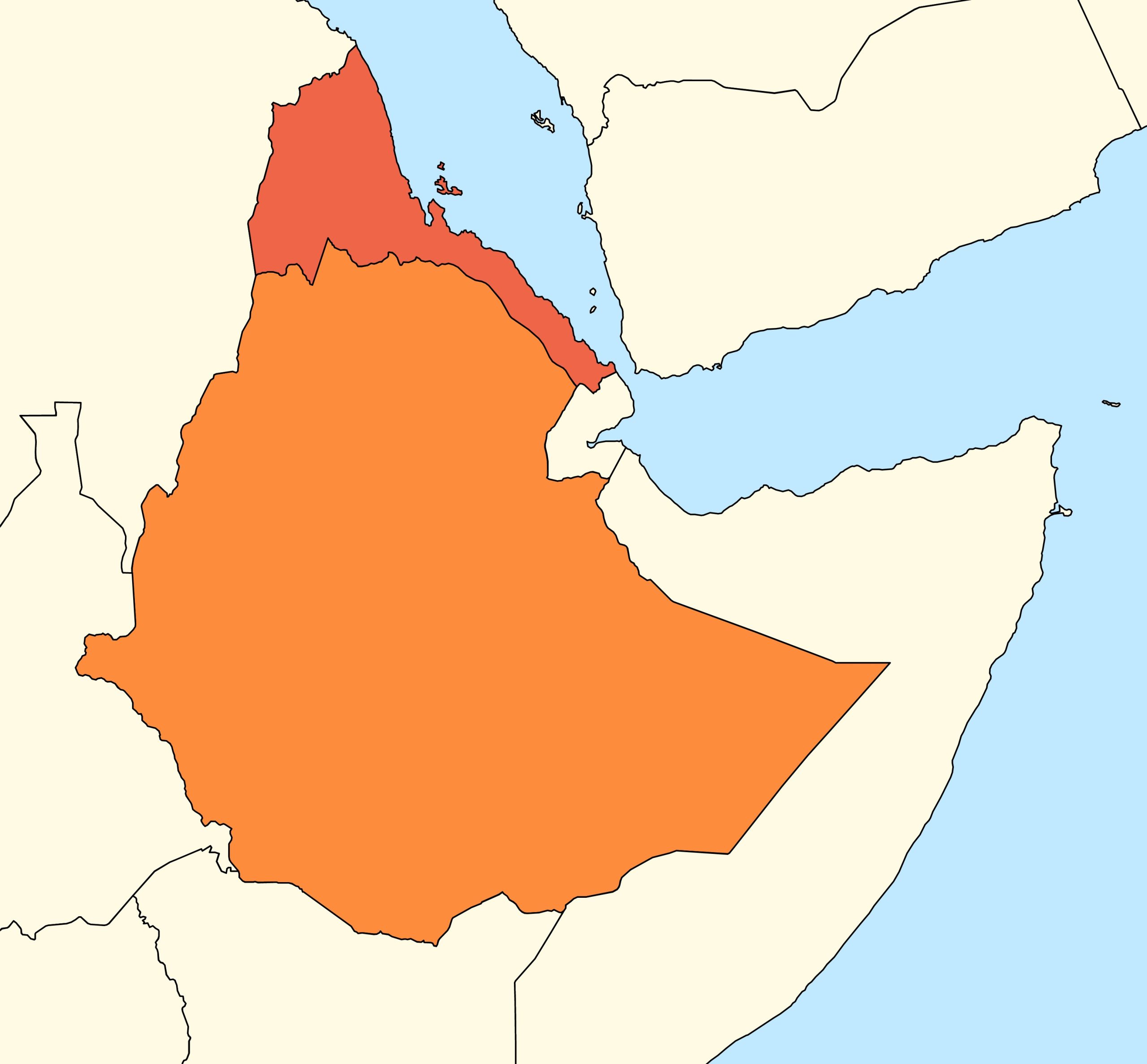
The border between Ethiopia and Eritrea, including the area around Badme in northwestern Tigray. Map: XTheBedrockX / Wikimedia Commons (CC BY-SA 4.0)
A drone strike on Monday wounded civilians who had returned for food near Badme, BBC Amharic reported, as monitors said Ethiopia and Eritrea had massed forces along their border.
The strike hit Biyara kebele, one of the rural kebeles near the town, on Monday, Nov. 16, sources told BBC Amharic. Danayt Atalay, the social affairs coordinator for Badme’s rural areas, said the wounded had fled earlier fighting to Sheraro and come back to collect food. She said the drone struck a white Isuzu truck, the only vehicle running the route, and that one woman and three men were hurt. The driver and his assistant were among them, she said.
Dr. Hagos Weldesemayat, a general practitioner at Mayami Hospital in Sheraro, told the BBC that the hospital treated two of the wounded. A 37-year-old woman with a serious eye injury was sent on to Suhul Hospital in Shire, he said, and a 22-year-old with lighter wounds was treated and sent home. “They were hit by fragments,” Hagos said. “There were many people, but they told us only four were hurt.”
According to an unnamed Badme resident who spoke to DW Amharic, a drone strike near Adi Hara at about 1 in the afternoon burned an Isuzu truck and wounded five people. A patient under treatment for injuries from the strike told the radio, “My eye was hurt.” The conflict monitor ACLED, in an update on its Ethiopia page, also placed the strike at Adi Hara in Biyara kebele, in Tahtay Adiyabo woreda, and said at least four civilians were injured. It described the drone as unidentified and said it was suspected to have been launched by Ethiopia’s army. No side has publicly claimed the strike.
Danayt told the BBC that 1,233 people displaced by the recent fighting have reached Sheraro, some in shelters and others staying with local families. One resident told DW Amharic that fear of further drone strikes is leading families toward Shire, Sheraro and other towns. He said the displacement, on top of a severe drought this year, has left mothers walking long distances, and that some have given birth by the roadside.
On Tuesday, the Northwestern Command Post ordered that no more than four people may gather anywhere in the zone, Tigray Television reported, as BBC Amharic recounted. The order, issued “to establish peace and security in the zone,” also bans bajaj three-wheelers and motorcycles after 6 in the evening, including in Shire. It limits other vehicles to set hours, with an exception for ambulances. ACLED said the same command post also suspended gold mining and required all weapons to be registered by Nov. 23.
Reuters reported on Wednesday that Ethiopia and Eritrea have massed forces along their shared border, according to ACLED, the International Crisis Group, and two people tied to rival armed groups in Tigray. The agency said it could not independently confirm reports of skirmishes between the two armies. ACLED said in a statement late Tuesday that Ethiopian drones targeted likely Eritrean positions around Badme on Nov. 12, and that Eritrean forces fired artillery toward Ethiopian positions. It said the two armies clashed on the Ethiopian side of the border the next day.
A person close to Tigrayan rebels told Reuters the two armies had clashed sporadically, without giving details. A person close to the Tigray Peace Force, which has fought alongside Ethiopia’s army, said federal troops were pursuing Tigrayan fighters toward the border and had not fought Eritrean forces. Magnus Taylor, an analyst at the International Crisis Group, did not confirm the reported clashes. He told Reuters that fighting near the border could draw Eritrea deeper into the war on the Tigrayan side, “a dangerous scenario that could trigger a direct conflict between Ethiopia and Eritrea.”
That disagreement over what is happening at Badme is not new. In a Nov. 14 report, BBC Tigrinya said unverified posts had claimed that Eritrean troops left Badme and that Ethiopia’s army had taken the town. Those claims, it said, did not match what residents and a Tigray Peace Force spokesperson described. Residents of Sheraro, Adi Hageray and Biyara said the heavy fighting that week was between the Ethiopian army and Tigray forces. One man who had fled Adi Kilte told the BBC, “There was no Eritrean army in the area.” Col. Solomon Hailemariam, a spokesperson for the Tigray Peace Force, said claims circulating about who holds Badme had no basis, and that his forces had no plan to clash with Eritrea.
ACLED later said that over the weekend Eritrean forces regained control of Badme, after pulling back in mid-October. It said they advanced toward Gual Gemhalo and Sembel, about 20 kilometers into Tigray, where they had reportedly set up defensive positions. Reuters could not independently confirm the reported clashes, and Zegabi could not independently verify who now holds the town. Eritrea’s information minister, Yemane Gebremeskel, told Reuters that Ethiopia’s ruling party was spreading “propaganda” about events near the border. He did not directly address the reports of a buildup or of clashes. By Wednesday evening, Zegabi had found no published comment on those reports from the authorities in Addis Ababa.
According to residents who spoke to DW Amharic, the heaviest border fighting took place last Tuesday and Wednesday, with two days of artillery and gunfire. One resident said it started after an Ethiopian drone struck an Eritrean position at Badme on Wednesday. Since then, he said, the area had been mostly quiet except for small arms fire. He told the radio that much of the fighting was between Ethiopia’s army and Tigray People’s Liberation Front forces. He said Eritrean troops had not fully withdrawn from the Irob and Badme areas that Eritrea claims. He also said both sides appeared to be preparing for what he called an unavoidable war. From Mekelle, a resident with family in Zalambessa told DW Amharic that nothing was moving in that border town, and that phones which had functioned through Monday night had been out since Tuesday morning.
The town of Badme sits at the center of the 1998 to 2000 border war, which killed tens of thousands of people. A boundary commission later ruled that it lies in Eritrea. Prime Minister Abiy Ahmed and President Isaias Afwerki signed a peace agreement in 2018, and their armies later fought on the same side in the 2020 to 2022 war in Tigray. Relations have collapsed this year over Ethiopia’s search for sea access, mutual accusations of supporting armed groups, and the rupture of diplomatic ties in early October. Witnesses and the Ethiopian Government have said Eritrean forces crossed into Tigray in early October. Asmara has denied any incursion and accused Addis Ababa of seeking a pretext for an invasion.
G7 foreign ministers, meeting in Paris on Nov. 9 and 10, called on all sides to show “maximum restraint” and to seek a diplomatic solution, BBC Tigrinya reported. A delegation of UN officials and ambassadors from eight countries arrived in Mekelle on Tuesday for talks with Tigray’s caretaker administration, as Zegabi reported.
Sources
- BBC Amharic, Nov. 18, 2026: at least four civilians wounded in a drone strike in Biyara kebele, near Badme (Amharic)
- DW Amharic, Nov. 17, 2026: residents on fighting and a drone strike near Adi Hara, and on families fleeing (Amharic)
- Mereja Media, Nov. 18, 2026: DW Amharic hears drone strike wounded five as families flee
- Reuters, Nov. 18, 2026: Ethiopia and Eritrea amass forces along border, heightening war fears, sources say
- ACLED, Conflict in Ethiopia: drone strike at Adi Hara, command post restrictions, and an update that Eritrean forces regained Badme
- BBC Tigrinya, Nov. 14, 2026: what happened on the Eritrea-Ethiopia border, and who holds Badme? (Tigrinya)
- Zegabi’s earlier reporting: 181176, 181332, 181486